
There's a specific kind of anxiety that comes with noticing something new or different on your skin. You catch a glimpse of it in the mirror, or your fingers brush over a rough patch that wasn't there before, and suddenly you're stuck in that uncomfortable middle ground between hoping it's nothing and worrying that it might be something. You google it, which only makes things worse because the internet has a way of convincing you that every freckle is melanoma and every dry patch is a rare autoimmune disorder. So you wait, hoping it will resolve on its own, and the longer you wait, the harder it becomes to know if you're being reasonable or if you should have called a dermatologist weeks ago.
If that sounds familiar, you're in extraordinarily good company. Dermatologists see patients every single day who start their appointment with some version of "I don't know if this is worth bothering you with" or "I probably should have come in sooner." Here's what we wish more people understood: there is no such thing as a concern too small to bring to a dermatologist. Part of our job is helping you figure out whether something needs treatment, monitoring, or just reassurance, and we genuinely can't do that unless you actually come in.
At Cleaver Dermatology & Aesthetics, our board-certified dermatologists across North Georgia have heard every version of "is this normal" that exists, and the honest answer is usually one of three things: yes it's normal, no it's not but it's easily treatable, or we need to keep an eye on it. All three of those are good outcomes, because all three of them are answers. Here's a look at the most common skin changes that bring people through our doors and what they typically mean.
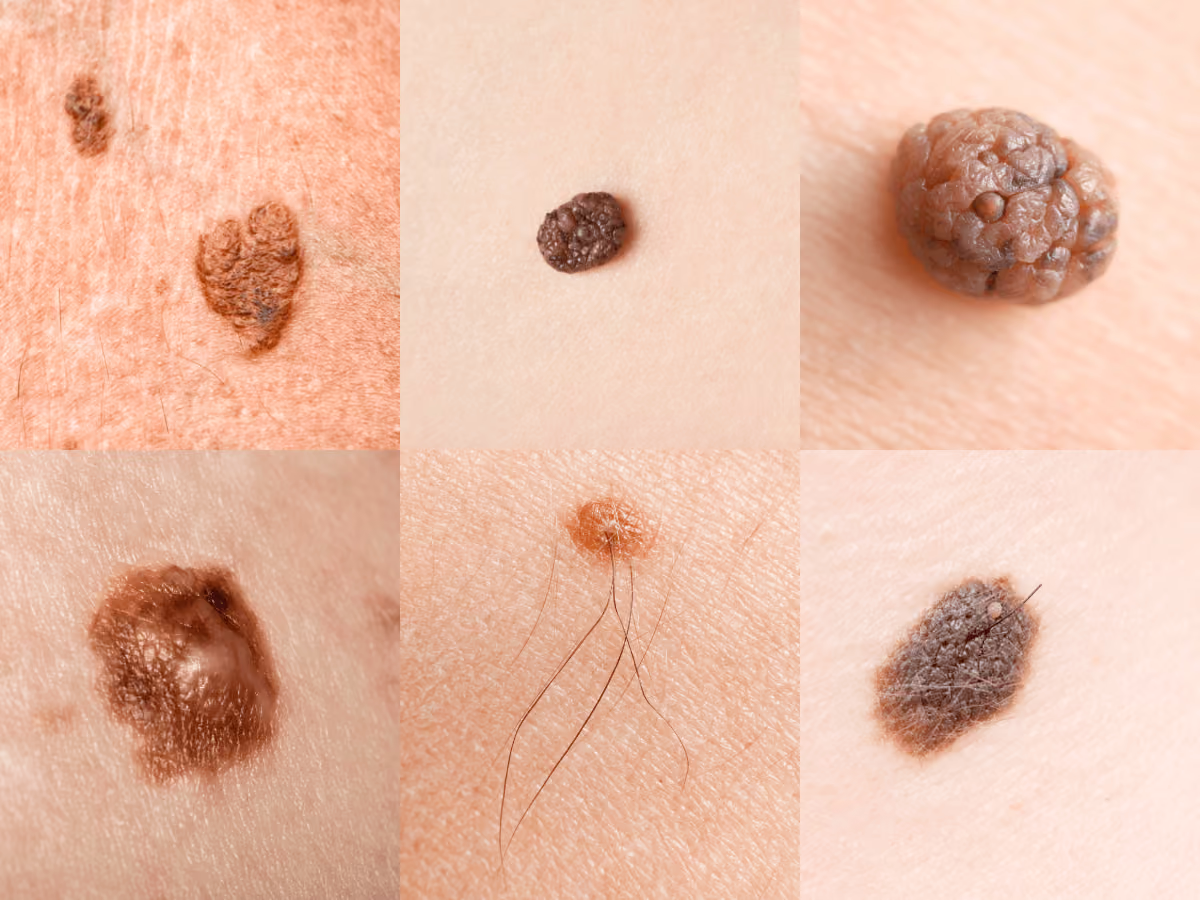
This is the concern that brings more people into a dermatology office than almost anything else, and for good reason. Most moles are entirely benign and will never cause a problem in your lifetime. But melanoma, the most serious form of skin cancer, often begins as a mole that changes or as a new spot that develops and doesn't look quite like the others.
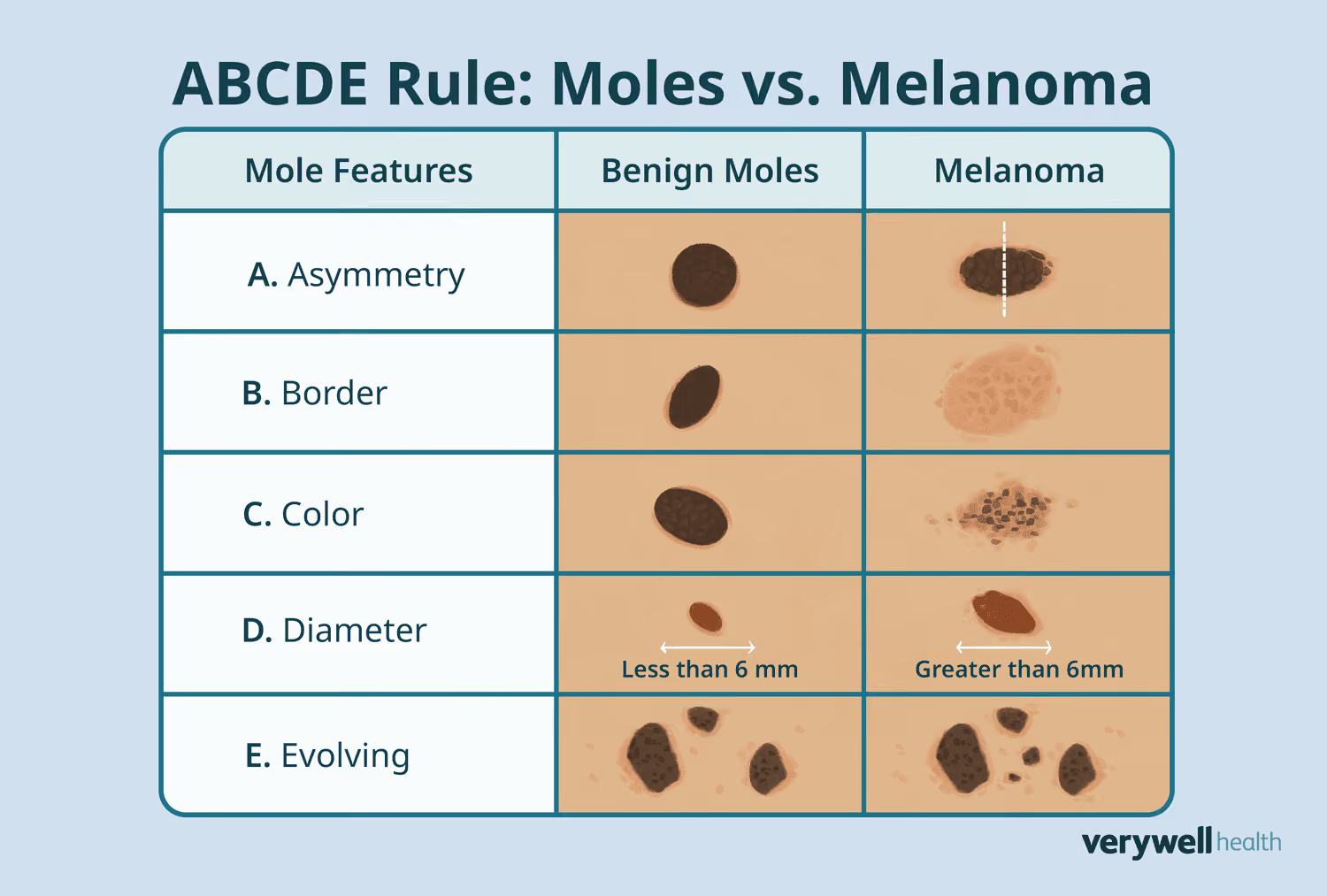
The challenge is that "different" is subjective. What does a concerning mole actually look like? Dermatologists use the ABCDE rule as a guideline. Asymmetry means one half of the mole doesn't match the other half. Border irregularity means the edges are ragged, blurred, or uneven rather than smooth and round. Color variation means the mole contains multiple shades of brown, black, red, white, or blue rather than a single consistent color. Diameter larger than a pencil eraser, roughly six millimeters, is worth having evaluated. Evolution, meaning any change in size, shape, color, or symptoms like itching or bleeding, is the most important warning sign of all.
But here's what patients need to hear more often: you don't need to be certain that a mole meets these criteria to justify an appointment. If something looks different to you, if your gut is telling you a spot has changed or doesn't look right, that is reason enough to have it checked. Dermatologists would much rather see a hundred benign moles than miss one melanoma because someone talked themselves out of coming in. At Cleaver Dermatology & Aesthetics, we examine moles, spots, and lesions every day, and we never want you to feel like you're wasting our time. You're not.
You've been moisturizing it for weeks, maybe months. It's a small area, usually on your face, ears, scalp, or the backs of your hands, and it feels like sandpaper no matter how much lotion you apply. It might be slightly pink or red, or it might be the same color as the surrounding skin, but it's persistently rough and it's not smoothing out.
This is often an actinic keratosis, a precancerous lesion caused by cumulative sun damage. Actinic keratoses are extraordinarily common in adults with significant lifetime UV exposure, which includes most people who have spent years living in a sunny state like Georgia. They are not cancer yet, but a small percentage of them will eventually develop into squamous cell carcinoma if left untreated, which is exactly why dermatologists take them seriously and treat them promptly.
The good news is that treatment is straightforward. Depending on the number and location of the lesions, your dermatologist may freeze them off with liquid nitrogen, prescribe a topical cream that causes the damaged cells to slough off and be replaced by healthy skin, or recommend photodynamic therapy for more widespread cases. The key is not ignoring them. If you have a persistently rough patch that hasn't responded to moisturizer after a few weeks, it's worth having evaluated sooner rather than later.
You thought it was a pimple, or maybe a scrape from something you didn't remember doing. But it's been weeks, and instead of healing, it keeps reopening, bleeding a little, scabbing over, and repeating the cycle. It might be a small sore, a shiny bump, or a red patch that just won't close up and go away.
This is one of the hallmark presentations of basal cell carcinoma, the most common form of skin cancer. Basal cell carcinoma grows slowly and almost never metastasizes, which is why it's considered the least dangerous of the skin cancers. But it is still cancer, and it needs to be treated. Left alone, it will continue to grow, becoming larger and more destructive to the surrounding tissue over time.
The reason this presentation confuses people is that it often doesn't look particularly alarming. It's not a big, dark, scary-looking mole. It's a little spot that just refuses to heal, and that's easy to dismiss as nothing for far longer than it should be. If you have any sore, bump, or spot that has been there for more than a month without healing, that is absolutely worth having a dermatologist take a look at. Early detection means simpler treatment and better cosmetic outcomes, particularly when the spot is on your face, which is where basal cell carcinoma most commonly develops.
Acne at any age is frustrating, but there's a particular kind of discouragement that sets in when you've tried everything over the counter and nothing is working. You've switched cleansers, used spot treatments, adjusted your diet, and still the breakouts keep coming, or worse, they're getting more severe. Cystic acne, the deep, painful kind that lingers under the skin for weeks, is particularly demoralizing and particularly resistant to drugstore solutions.
This is one of those situations where waiting and hoping is rarely the answer. Adult acne, hormonal acne, and cystic acne almost always benefit from prescription treatment, and the longer you wait, the greater your risk of scarring and post-inflammatory hyperpigmentation. A dermatologist can prescribe topical retinoids, oral antibiotics, hormonal therapies like spironolactone for women, or isotretinoin for severe cases. These treatments work, and they work in a way that over-the-counter products simply cannot match.
Patients often tell us they wish they had come in sooner, and we get it. There's a sense that acne is something you should be able to handle on your own. But persistent acne is a medical condition, not a personal failing, and treating it as such is what finally gets people the clear skin they've been working toward for years.
Your skin flares up, gets red and uncomfortable, maybe even develops dry patches or tiny bumps, and then it settles down for a while before coming back again. You've tried switching laundry detergent, avoiding certain foods, using gentler products, but the pattern continues without a clear trigger. It's maddening because it feels like it should have an obvious cause, and yet you can't figure out what it is.
This type of reactive, cyclical skin issue could be eczema, rosacea, contact dermatitis, or a number of other chronic inflammatory skin conditions, and figuring out which one you're dealing with is the first step toward actually managing it. These conditions rarely resolve on their own, and they often get worse over time without proper treatment. A dermatologist can assess your skin, identify the underlying condition, and put together a treatment plan that includes prescription topicals, lifestyle modifications, and a skincare routine that supports your skin rather than aggravating it.
For patients dealing with eczema, rosacea, or other chronic conditions, Cleaver Dermatology & Aesthetics offers comprehensive care that goes beyond just handing you a prescription. We help you understand what's happening in your skin, what your triggers are, and how to manage flares when they do occur so that you're not constantly caught off guard.
This is the hardest category to define, but it's one of the most important. Sometimes patients come in without a clear diagnosis in mind. They just know that something feels off. A spot that tingles, an area that itches persistently, a texture change that's hard to describe, or just a nagging sense that something has shifted and they can't quite put their finger on what.
Trust that instinct. You know your own skin better than anyone else, and if something feels wrong to you, that is sufficient reason to have it evaluated by a professional. Dermatologists are trained to look at thousands of subtle variations in skin health, and part of what we do well is distinguishing between what's benign and what needs attention. You don't need to diagnose yourself before you walk in the door. You just need to show us what you're concerned about, and we'll take it from there.
One of the most consistent pieces of feedback we hear from first-time patients at Cleaver Dermatology & Aesthetics is relief. Relief that they finally asked, relief that the appointment was easier than they expected, and relief that they have a clear answer instead of weeks or months of uncertainty. Whether the answer is reassurance that everything is fine, a simple treatment plan, or the early detection of something that needed attention, all of those outcomes are better than waiting and worrying.
If something on your skin has been bothering you, if you've been googling symptoms at midnight, or if you've been putting off an appointment because you're not sure if it's "serious enough," let us be the ones to make that call. Dr. Nathan Cleaver, Dr. Stephanie S. Gardner, Dr. Weston Waxweiler, and our entire dermatology team serve patients across Cumming, Gainesville, Roswell, Johns Creek, Dahlonega, Canton, Toccoa, Lavonia, and Dawsonville with the kind of expert, compassionate care that every patient deserves. Book your appointment online today and let us give you the answers you've been looking for.
Lorem ipsum dolor sit amet, consectetur adipiscing elit. Suspendisse varius enim in eros elementum tristique.

