
Your skin is the largest organ in your body, and it works hard every single day, protecting you from the sun, the elements, and the outside world. But because it's always exposed, it's also the most vulnerable to changes that can quietly develop over time. Skin cancer is the most commonly diagnosed cancer in the United States, and the good news is that when caught early, it is also one of the most treatable. That's exactly why a yearly skin cancer screening is one of the simplest and most important things you can do for your long-term health.
Most people don't skip their annual physical or dental checkup without a second thought. But skin checks? They tend to fall to the bottom of the list, often because people assume that if nothing looks obviously wrong, everything must be fine. The problem is that some of the most concerning skin changes are subtle, slow-moving, and easy to miss without a trained eye. A board-certified dermatologist can spot the difference between a harmless mole and something that needs attention, and catching it early is what makes all the difference.
At Cleaver Dermatology and Aesthetics, our team of board-certified dermatologists and specialists serves patients across North Georgia, including Cumming, Dahlonega, Gainesville, Canton, Roswell, Johns Creek, Toccoa, and Lavonia. Whether you've never had a skin check before or you're overdue for one, here's everything you need to know before you book your appointment.
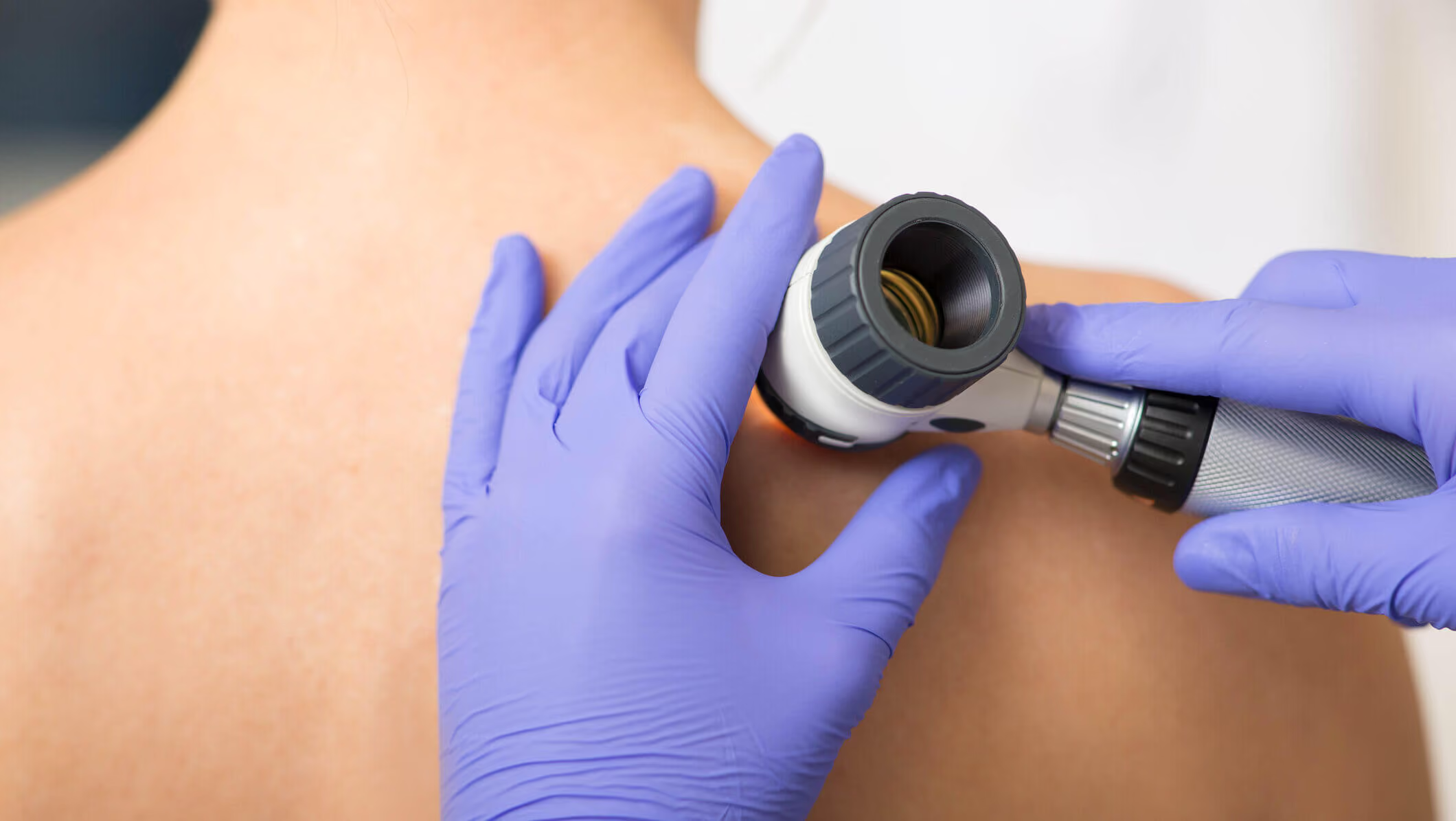
A skin cancer screening is a full-body examination performed by a dermatologist to look for any unusual spots, moles, or lesions on your skin. It is non-invasive, relatively quick, and can be done at your regular dermatology appointment. You don't need to have a specific concern to schedule one, routine screenings are for everyone.
During the exam, your dermatologist will systematically examine your skin from head to toe, including areas you may not easily see yourself, like your scalp, the back of your neck, between your toes, and the soles of your feet. They're looking for anything that appears asymmetrical, has irregular borders, shows multiple colors, is larger than a pencil eraser, or has changed recently. These are the classic ABCDE warning signs of melanoma, and knowing them matters whether you're seeing a doctor or doing a self-check at home.
The exam itself typically takes less than 30 minutes. If your provider notices something worth watching or investigating further, they may recommend a biopsy, which involves removing a small sample of skin tissue to be examined under a microscope. That is the only definitive way to know whether a spot is cancerous.
For most adults, a full-body skin cancer screening once a year is the standard recommendation. However, your ideal frequency depends on several personal risk factors, and your dermatologist is the best person to help you determine what's right for your situation.
You may need more frequent screenings if you have a personal or family history of skin cancer, if you've had significant sun exposure over your lifetime, if you have fair skin that burns easily, if you've used tanning beds, or if you have a large number of moles. Patients who have previously been treated for skin cancer are typically monitored every three to six months, depending on the type and stage of their diagnosis.
People with darker skin tones are not exempt from skin cancer, though the risk profile differs. Acral lentiginous melanoma, for instance, tends to develop on the palms of the hands, soles of the feet, and under the nails, and it occurs more frequently in people with darker skin. Regular screenings help catch these presentations that might otherwise be overlooked.
Almost everyone has moles, and the vast majority of them are completely benign. A typical mole is round or oval, evenly colored (usually tan, brown, or a consistent shade), has smooth and well-defined edges, and is generally smaller than 6 millimeters in diameter. Most benign moles appear before the age of 30 and remain stable for years.
What raises concern is change. A mole that starts to grow, change shape, bleed, itch, or take on multiple colors deserves a professional evaluation. New moles that appear after age 35 are also worth having looked at. The ABCDE rule is a helpful guideline: Asymmetry, Border irregularity, Color variation, Diameter larger than a pencil eraser, and Evolution or change over time.
That said, not every dangerous spot looks like a textbook warning sign, and not everything that looks worrying turns out to be cancerous. The point of a professional skin check is not to alarm you, it's to give you a clear, accurate picture of your skin's health from someone who has examined thousands of patients and knows what to look for.
If a skin cancer is detected, treatment options depend on the type, size, and location of the cancer. One of the most effective and precise treatments available for certain skin cancers, particularly basal cell carcinoma and squamous cell carcinoma, is Mohs micrographic surgery.
Mohs surgery is a specialized technique in which thin layers of cancerous skin are removed one at a time and examined under a microscope immediately, right there in the office. The surgeon continues removing tissue layer by layer until no cancerous cells remain. This approach allows for the highest possible cure rate, often exceeding 99 percent for early-stage basal cell carcinoma, while sparing as much healthy surrounding tissue as possible.
At Cleaver Dermatology and Aesthetics, Nathan Cleaver, D.O. is a fellowship-trained, board-certified dermatologist who specializes in Mohs surgery. For patients in North Georgia who receive a skin cancer diagnosis, having access to that level of surgical expertise locally, without needing to travel to Atlanta or beyond, is a significant advantage. Dr. Cleaver performs Mohs procedures at multiple locations throughout the region, ensuring that patients receive exceptional, specialized care close to home.
Seeing a dermatologist annually is essential, but your skin changes year-round, which is why self-exams are a valuable complement to professional screenings. Once a month, take 10 minutes in a well-lit room to examine your skin from head to toe. Use a full-length mirror and a hand mirror to check hard-to-see areas like your back, scalp, and the backs of your legs.
Get familiar with your own skin so that you'll notice if something changes. Take note of moles, freckles, and marks you already know about. If something new appears, or if something you've had for years starts looking or feeling different, that's your cue to call your dermatologist sooner rather than waiting for your next annual visit.
Early detection is not just a talking point, it's the single most powerful factor in skin cancer survival rates. Melanoma caught at its earliest stage has a five-year survival rate of over 99 percent. When it spreads, that number drops significantly. A monthly self-exam costs nothing and could quite literally save your life.
Georgia's climate means abundant sunshine nearly year-round. Long summers, outdoor recreation, and plenty of time spent on lakes, trails, and golf courses all add up to more cumulative UV exposure than many people realize. UV radiation doesn't just affect you on beach days, it accumulates with every drive, every walk outside, every hour you spend near a window. Over years and decades, that exposure takes a toll on the skin, even for people who are diligent about sunscreen.
Patients across Cumming, Gainesville, Dahlonega, Toccoa, Lavonia, Canton, Roswell, and Johns Creek all share this climate reality. That makes routine dermatological care not just a good idea, but a genuinely important part of living well in this part of the state.
Healthy skin doesn't happen by accident, and catching problems early is always better than treating them late. If you can't remember the last time you had a full-body skin check, that's a good sign it's time to schedule one. The team at Cleaver Dermatology and Aesthetics, including board-certified dermatologists Dr. Nathan Cleaver, Dr. Stephanie S. Gardner, and Dr. Weston Waxweiler, is here to give you expert, compassionate care at every step. Book your appointment online today at one of our convenient North Georgia locations and take the first step toward skin you can feel confident in.

Lorem ipsum dolor sit amet, consectetur adipiscing elit. Suspendisse varius enim in eros elementum tristique.

